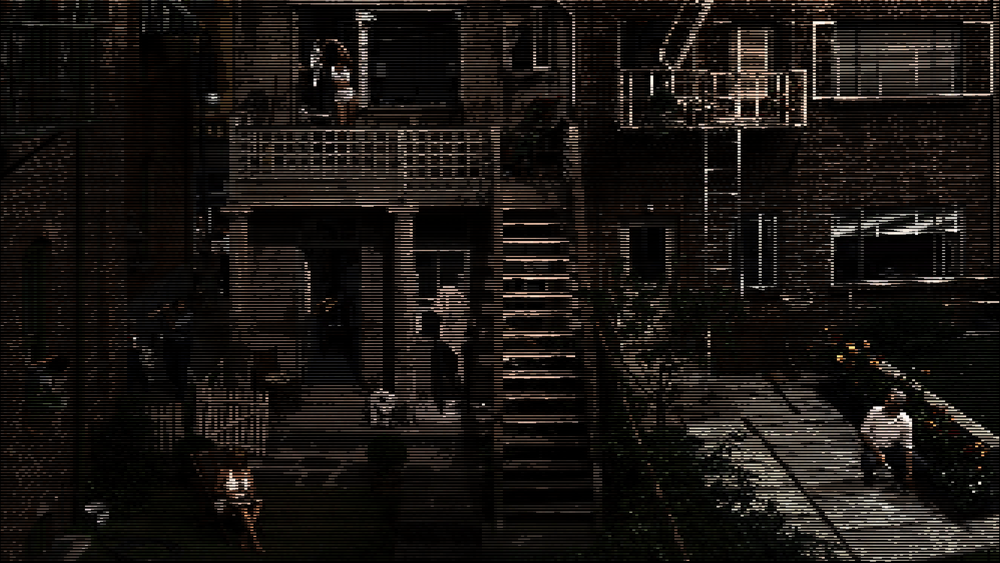
It's summer. The asphalt is cooking, a close-up of a thermometer makes sure we know exactly how badly, and in a cramped New York apartment block, nearly every window is thrown wide open against the heat. That's the setting Alfred Hitchcock drops us into at the start of "Rear Window" (1954): a photojournalist named L.B. Jefferies, "Jeff" (James Stewart), stuck in a wheelchair with a leg in a cast, starts watching his neighbors across the courtyard out of sheer boredom, and stumbles onto what might be a murder.
That premise alone wouldn't be remarkable. What makes "Rear Window" one of the most studied films in Hitchcock's catalogue is the formal decision sitting underneath it: for the entire runtime, the camera never once leaves Jeff's apartment, and rarely leaves his point of view. Everything the audience learns, suspects, or misreads, they learn, suspect, and misread exactly when Jeff does. It's a genuinely radical piece of visual storytelling wrapped inside what looks, at first glance, like a fairly conventional thriller.
The Opening Shot That Explains Everything
Before a single word of dialogue is spoken, the film's opening sequence tells you everything you need to know about the next 112 minutes. The camera drifts slowly across the courtyard, taking in the block, and lingers just a beat too long on the wide-open window of a lightly dressed young woman across the way. It's a small moment, easy to miss, but it immediately establishes what kind of film this is going to be: whenever the camera isn't showing Jeff directly, it's adopting his gaze, and the audience is seeing the courtyard's private moments through the eyes of a curious photographer who really shouldn't be looking.
Cinematographer Robert Burks builds on that idea with long, slow pans that repeatedly put the viewer back into the position of observer, sweeping across the different apartments and the different lives unfolding inside them. When Jeff wakes up during a rainstorm one night, his eyes drift back to the courtyard out of habit, and he notices a neighbor leaving the building repeatedly, suitcase in hand, at an odd hour. After a time jump (visualized, appropriately, through fades rather than cuts) his sickly, bedridden neighbor appears to have vanished the next morning, and Jeff watches through binoculars, then a telephoto lens, as Mr. Thorwald (Raymond Burr) wraps a knife and a saw in newspaper. From there, Jeff's suspicion only grows, along with a theory about what actually happened that neither we nor he can fully confirm.
A Camera as Trapped as Its Protagonist
What's easy to overlook on a first watch is how carefully the framing itself tracks Jeff's access to information. Early on, the neighboring windows are shot almost exclusively in wide and extreme wide shots, distant and general, the kind of view you'd actually get with the naked eye from across a courtyard. As Jeff reaches for his binoculars and eventually his telephoto lens, the film's own shot language changes with him: medium shots and closer framings start appearing, revealing details that simply weren't visible before. Hitchcock even adds a dark vignette around these closer shots, mimicking the circular view through a magnifying lens and making the illusion that much more convincing. The camera, in other words, only sees as much as Jeff's equipment lets him see, and not a frame more.
That restriction becomes the film's real engine of suspense. Jeff's own apartment, the second recurring location in the film, gets noticeably fewer point-of-view shots; the scenes there are mostly shot in conventional medium and medium-close framing as Jeff talks with his nurse Stella (Thelma Ritter) and his girlfriend Lisa (Grace Kelly), who both start off treating his suspicions as the paranoid hobby of an "incurable Peeping Tom," before mounting evidence turns them into willing accomplices. Even here, though, the camera stays locked to the room: it never once follows Lisa into the kitchen, for instance, when she goes to pour a drink for Jeff and his detective friend Doyle (Wendell Corey).
That refusal to leave the apartment, ever, is the real trick. Because there are no parallel-edited scenes showing Thorwald on his nighttime errands, or Doyle conducting his own investigation elsewhere, the audience is stuck guessing right alongside Jeff, with exactly the same incomplete picture. It's a camera that shares its protagonist's physical confinement, and that confinement is precisely what keeps the tension climbing scene after scene, right up to the film's climax, when Lisa and Stella finally take matters into their own hands and break into Thorwald's apartment themselves. Only then does the editing speed up and the camera finally step outside Jeff's window, following Stella and Lisa's perspective instead as Thorwald shoves Jeff out toward the courtyard below.
Windows as Television Screens
Beyond the central mystery, and beyond the fairly obvious parallel between the ailing, immobilized Mrs. Thorwald and Jeff's own condition, it's the other windows in the courtyard that end up doing a surprising amount of narrative work. Their rectangular shape practically invites the comparison to individual television screens, each one framing its own tiny, self-contained story: a spy-thriller-adjacent mystery in one, a slice of character drama in another, a comedy here, a quietly tragic romance there. As Jeff's attention drifts between them, these miniature stories keep reflecting his own situation back at him, most obviously his uncertain relationship with Lisa, without ever needing a line of dialogue to make the point explicit.
Take Miss Lonelyhearts, the woman in one of the lower apartments who sets an elegant table for an imaginary dinner date, or the newlywed couple who vanish behind drawn blinds the moment they move in, only to have those same blinds fly back open days later once the initial spark has clearly worn off. Neither storyline touches the murder plot in any direct way, and neither needs to. Each window becomes a small commentary on love, loneliness, or commitment, quietly running in parallel to whatever Jeff is deciding about his own relationship with Lisa in that same scene. It's an efficient piece of storytelling: rather than spelling out Jeff's ambivalence about settling down through dialogue, Hitchcock just lets him glance out the window at a dozen other versions of what that choice might look like.
Two Relationships, One Courtyard
The Thorwalds function as more than just a murder subplot dropped into the film for convenience. Structurally, they're a dark mirror held up to Jeff and Lisa: a bedridden spouse confined to one room, an able-bodied partner increasingly restless and resentful of that confinement. It's not hard to read Jeff's fascination with the case as fascination with a worst-case version of his own situation, a fear of where staying immobile, literally and otherwise, with the wrong person might eventually lead. Lisa, for her part, spends much of the film trying to prove she can adapt to Jeff's rougher, more adventurous lifestyle rather than the other way around, going as far as breaking into a murderer's apartment to do it. Whether that's meant as a genuine character arc or a slightly cynical joke about what it takes to win Jeff over is left mostly to the audience to decide, which is very much in keeping with a film that trusts its viewers to draw their own conclusions from what they're shown rather than told.
Color, Light, and Shadow as Storytelling Devices
Visually, "Rear Window" leans into warm, saturated color to sell the feeling of a lively, sweltering New York summer during the day, occasionally tipping into something that reads as almost deliberately artificial: as the first night sets in, the sky is dyed a surreal, near-hallucinatory orange, a small visual cue that seems to be warning the audience before anything actually happens.
At night, Hitchcock switches tools entirely, and light and shadow become the film's most visible piece of craft. Thorwald, our suspected killer, is only ever identifiable in the dark by the glow of his cigarette; Jeff and Lisa, in turn, retreat into shadow themselves whenever they want to stay unseen. That visual grammar shows up early in a scene that quietly foreshadows the finale: as Lisa leans in to kiss Jeff, her shadow briefly falls across his face, a small visual rhyme for the moment, much later, when Thorwald looms over him in his own apartment. Light also becomes something the characters actively wield rather than simply exist inside. Lisa switches the lamps on to show off a glamorous new dress; other characters switch them off to stay hidden. And in the film's tensest moment, it's Jeff himself who turns light into a weapon, firing off his camera's flash to try to blind Thorwald as he closes in.
A Soundtrack That Lives Inside the Film's Own World
Franz Waxman's score is used with real precision, deployed to underline specific beats rather than blanket the whole film. But the more interesting choice is in the sound design around it: Hitchcock builds the film's atmosphere almost entirely out of diegetic, in-world sound. We hear the general noise of the city, the fabric of a busy New York summer, along with rain, and half-heard conversations drifting out of open windows. What's unusual, and genuinely clever, is that nearly every piece of music we hear in the film can be traced back to a specific source inside the story itself, a composer who happens to live across the courtyard from Jeff, audible whenever he turns on the radio, plays piano alone, or throws a party for his friends.
That composer's slowly evolving jazz ballad, "Lisa," becomes the film's actual musical theme, built up piece by piece over the runtime, and it does real narrative work in one of the film's most quietly devastating scenes, helping talk a lonely, suicidal neighbor back from the edge. Aside from the opening and closing credits, Hitchcock avoids any music that isn't sourced from somewhere inside the world of the film. Even ambient sounds like distant conversation or passing traffic are mixed to match what would actually be audible from Jeff's specific vantage point, which does more than build atmosphere: it puts the audience inside Jeff's perspective not just visually, through the camera, but audibly too, hearing the courtyard exactly as he would.
The Uncomfortable Question at the Center of It All
It's genuinely impressive how much variety Hitchcock finds within a single, fixed location. Despite never leaving the courtyard and Jeff's apartment, "Rear Window" builds a tightly constructed, chronologically told thriller that keeps the audience in the dark just long enough to let tension build steadily across the runtime. If there's a weak point, it's the finale, which resolves the actual murder mystery in a way that feels a touch too simple next to everything that came before it.
But the film's real achievement isn't really the mystery plot at all. It's how the visual and sound design work together to put the audience directly into Jeff's position, and by extension, into the role of voyeur right alongside him, sharing in his morally questionable habit of watching his neighbors' private lives unfold without their knowledge. Stella, Lisa, and Jeff all raise the ethics of what he's doing at various points, and none of them can quite stop watching either, any more than the audience can look away from the screen. Hitchcock's closing move is a small, ironic joke at his protagonist's expense: Jeff survives the ordeal with a black eye and, fittingly, a second broken leg.
The film's own protagonist puts the underlying question best, in a line that could just as easily be aimed at the audience in the dark as at himself: "I wonder if it is ethical to watch a man with binoculars and a long-focus lens. Do you, do you suppose it's ethical even if you prove that he didn't commit a crime?"
Nearly seventy years later, that question hasn't gotten any less uncomfortable to sit with. If anything, it's only gotten sharper: an audience that now spends its own free time scrolling through strangers' curated lives on a phone screen is arguably in a weaker position to judge Jeff than the audiences of 1954 were. That's exactly why "Rear Window" still holds up as one of the sharpest, most self-aware thrillers ever made about the simple, not-so-innocent act of looking.